


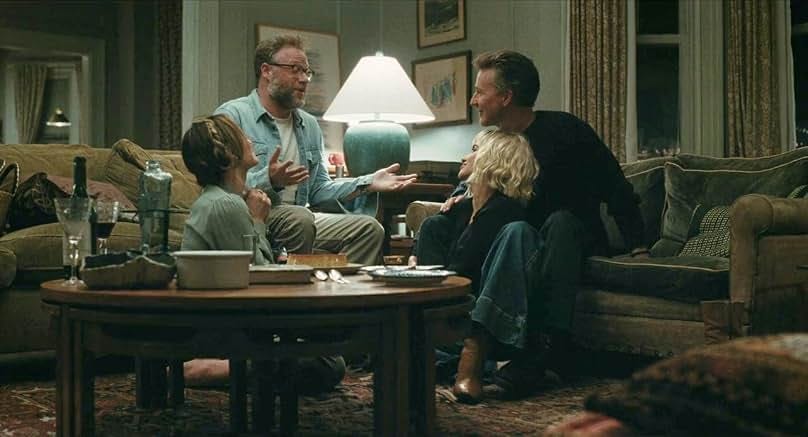
I recently watched Olivia Wilde’s The Invite, and what started as an entertaining movie about two very different couples sent me down a much bigger rabbit hole: relationships, non-monogamy, orthodoxy, aging, desire, menopause, ego strength, and the strange human urge to trade one restrictive script for another. Maybe most of all, it made me think about what it means to actually author your own life.
I’ve been with my spouse for thirty years, and I’m also a psychologist who co-founded Open Minds and has worked with many people in unconventional relationships. By the time someone lands on my couch, they are usually already deep in the weeds of their particular journey. I’m rarely there at the blueprint stage. One thing I’ve become increasingly skeptical of, though, is what I think of as non-monogamy orthodoxy.
There is a peculiar irony in escaping rigid traditional relationship scripts only to replace them with another hyper-regulated collection of ideas about how one is supposed to be “correctly” non-monogamous. To me, that seems to defeat much of the point. Rules can create an illusion of safety, while designing a custom roadmap requires a tremendous tolerance for ambiguity and a willingness to stay awake. Following a manual is much easier.
Intimate life has a way of biting back whenever we go on autopilot. Jealousy arrives. Envy arrives. Desire changes. Bodies change. People change. Someone unexpectedly falls in love; someone unexpectedly stops wanting sex; someone discovers something about themselves at fifty that they couldn’t possibly have known at thirty. A prepackaged rulebook can only take you so far. Eventually the real question becomes: What actually works for us now?
That question interests me far more than whether someone is obeying the conventions of ethical non-monogamy, polyamory, swinging, or anything else. It was also one of the things I found fascinating about The Invite. The upstairs couple, Hawk and Piña, are sexually unconventional, but their real contrast with Joe and Angela downstairs is larger than sex. They appear to have remained active participants in the creation of their lives, while Joe and Angela seem asleep at the wheel.
The latter couple’s disdain for one another has become almost ambient. From a Gottman perspective, the Four Horsemen are everywhere: criticism, defensiveness, stonewalling, and above all contempt. They aren’t simply disagreeing. They have begun communicating that the other person is ridiculous, and that is a very different thing.
It made me think about the way people sometimes imagine opening a relationship will somehow solve a connection that has already gone emotionally dead. Sexual experimentation can become another attempted fix: attention becomes proof that you’re still desirable, being wanted becomes proof that you’re still valuable, and freedom becomes proof that you’ve evolved.
Those are intense burdens to place on any experience. Worth is innate. It cannot actually be conferred by someone finding you sexually desirable, just as it cannot be removed when someone doesn’t.
There is also an interesting muddling in the film between different forms of consensual non-monogamy. For example, many swingers desire remaining physically together during activities and actually see it as part of the safety structure. The experience is shared: you are in the same room, with transparency, playfulness, erotic connection, compersion, and immediate reassurance. The underlying frame is essentially, “We are doing this together.”
So I found it interesting that when Piña suggests splitting into separate rooms, the film treats this almost as the gentler introduction. From another perspective, it is a much bigger leap. Separate rooms suddenly ask each person to navigate erotic and emotional intimacy autonomously. For a couple as fragile as Joe and Angela, that separation becomes a wedge, which may be why the scene works even if I’m not entirely convinced by its relationship mechanics. They are already living separate lives; the separate rooms simply make it visible.
Another thing I loved about the film was Olivia Wilde’s willingness to let Angela look slightly disheveled. The director and actor resists the Hollywood tendency to preserve female glamour even when the character is supposed to be emotionally depleted. Wilde doesn’t do that. Angela looks tired, flattened, disappointed. She and Joe look like two people who have decayed together.
Then Penélope Cruz and Edward Norton come downstairs as this visually and erotically vibrant pair, and the contrast is immediate. Cruz apparently insisted on Piña’s platinum blonde wig because she thought represented the character’s adventurous openness and vivacity. Wilde initially questioned it, then saw the transformation happen once Cruz put it on. I love that choice, especially because Piña never becomes simply decorative or symbolic. She identifies herself as both a therapist and sexologist—a clinical expert (and Esther Perel stand-in) who remains unapologetically feminine and sensual in her presentation. She is allowed to be strange, perceptive, warm, and eventually quite irritated.
I especially loved that Piña loses her temper. Had Hawk and Piña remained serenely enlightened throughout the evening, the movie would have collapsed into an advertisement for how evolved unconventional people are. Instead, Piña gets saturated. She becomes reactive and human. As a therapist, that registered with me immediately. Spend enough time inside a room filled with relational contempt and eventually you can feel it in your own nervous system.
The distinction, of course, is not that healthy couples never rupture. It is what they do with rupture. Joe and Angela fight in ways that widen the distance between them, while Hawk and Piña can become angry without turning the anger into a referendum on the other person’s worth. That, to me, is the strength of their underlying relational infrastructure.
And apparently Hawk’s deepest value proposition wasn’t even in the screenplay. [Minor spoiler] Edward Norton created the third-act story about Hawk’s former identity. He kept it private from Wilde before filming, so the emotional reaction we see from everyone was their actual first response to hearing it. That revelation completely changed the character for me. Suddenly Hawk’s almost irritating certainty about how life should be lived has a history beneath it. He knows something about regret. His vitality is not simply carefree hedonism; it has death standing behind it.
The Freedom to Go Your Own Way
That gets much closer to what interests me about living deliberately. At fifty-two, I find myself increasingly uninterested in cultural stories about what my life is supposed to look like, and I feel this particularly strongly around menopause. I’m glad women are finally speaking openly about difficult symptoms and receiving medical attention that previous generations were denied. At the same time, I sometimes feel the cultural pendulum beginning to turn a natural developmental transition into a condition of female pathology.
My own experience has been considerably more liberating. My libido has changed, and I don’t necessarily experience that as loss. I can look backward now and see that some portion of my younger sexuality was entangled with ego: the desire to be wanted, to be worshipped, to be confirmed externally. I don’t particularly need that anymore, and the amount of mental and creative real estate that has opened in its place is astonishing. I want to write books. I want to think. I want to create.
As for my thirty-year partnership, we aren’t required to arrive at the same developmental destination simultaneously. That may be one of the great gifts of an enduring relationship: we can remain deeply connected while allowing one another to become increasingly distinct. No mainstream marriage manual can predict a particular arrangement, and neither could a mainstream ENM manual. We built it, and we keep building it—bespoke.
Maybe that is what I mean by staying awake at the wheel.
The film ends with another small turn of events that I loved. Piña specifically wants her flan pan back, and then she and Hawk leave without it. I don’t know whether the filmmakers intended all the symbolism I immediately projected onto that abandoned object, but I like my interpretation. It feels like a heartfelt therapeutic flourish. Signifying unfinished business left behind and therefore a reason to return. And for the couple left by themselves again and perhaps too ready to forget all this commotion: a physical reminder that this bizarre yet enlightening night did actually happen.
Hawk and Piña almost begin to feel like relational ghosts who descended from upstairs, disrupted a stagnant system, and disappeared once their work was finished. Joe and Angela are left behind with the pan, the wreckage of the evening, and the piano. I genuinely don’t know whether that final piano scene means their relationship is beginning again or ending beautifully, and apparently Olivia Wilde doesn’t entirely know either. That ambiguity feels right. There doesn’t always have to be a diagnostic conclusion. Sometimes a crisis simply wakes you up, and what you do once you are awake is another question entirely.
Which brings me somewhere seemingly far from The Invite, although perhaps it isn’t far at all.
Lately I’ve been thinking about women like Shere Hite and Anaïs Nin, women who investigated experience that the dominant culture either misunderstood or actively rejected. One thing I’m excited about is the current reclamation of feminist heroes such as Hite, who is the subject of a 2023 documentary, The Disappearance of Shere Hite. Hite asked women about their own sexual lives and discovered answers the existing establishment did not particularly want to hear (naming the obvious fact that most women cannot achieve orgasms simply from penetrative sex—and I would say this is a reality for anyone of any gender when you are the receptive partner; direct stimulation of genitals has always been the go to). As for Nin, she created an enormous subterranean archive of female interiority and desire that exceeded what her cultural moment could comfortably hold.
I think about them in relation to two impulses I’ve been playing with conceptually, borrowed from nature: the pageantry drive and the camouflage drive. The pageantry drive wants visibility, recognition, celebration, the spotlight. The camouflage drive understands the generative safety of the fringe. Sometimes obscurity is protective. Sometimes being misunderstood buys you time. Sometimes you can create something much stranger and more truthful when the mainstream isn’t paying very much attention. It’s like how we are always talking about, “the spaces in between” in Ericksonian work; because that is where the magic happens.
I grew up culturally comfortable on those fringes with my Scandinavian artist mother and World War II era Filipino father in pre-gentrified Echo Park, and perhaps that has become more valuable to me with age. I’m less interested in forcing my work into whatever ideological or professional orthodoxy happens to be ascendant at the moment. I can write something, put it into the world, let the people who recognize it recognize it, and let the rest pass by. Maybe the future eventually catches up. Maybe it doesn’t. Either way, there is enormous freedom in realizing that your job is to create the life and work that are actually yours.
Thirty years into my relationship, fifty-two years into my life, and increasingly deep into my own work as a writer, therapist and seeker, I think this may be the common thread I keep discovering. We are handed scripts everywhere: for partnership, sex, aging, menopause, success, professional respectability, socialization and even how to rebel, be spiritual or personally evolve. Eventually there comes a point when another question becomes much more interesting:
What happens if I stop asking which script is correct and start paying attention to what is actually true?