


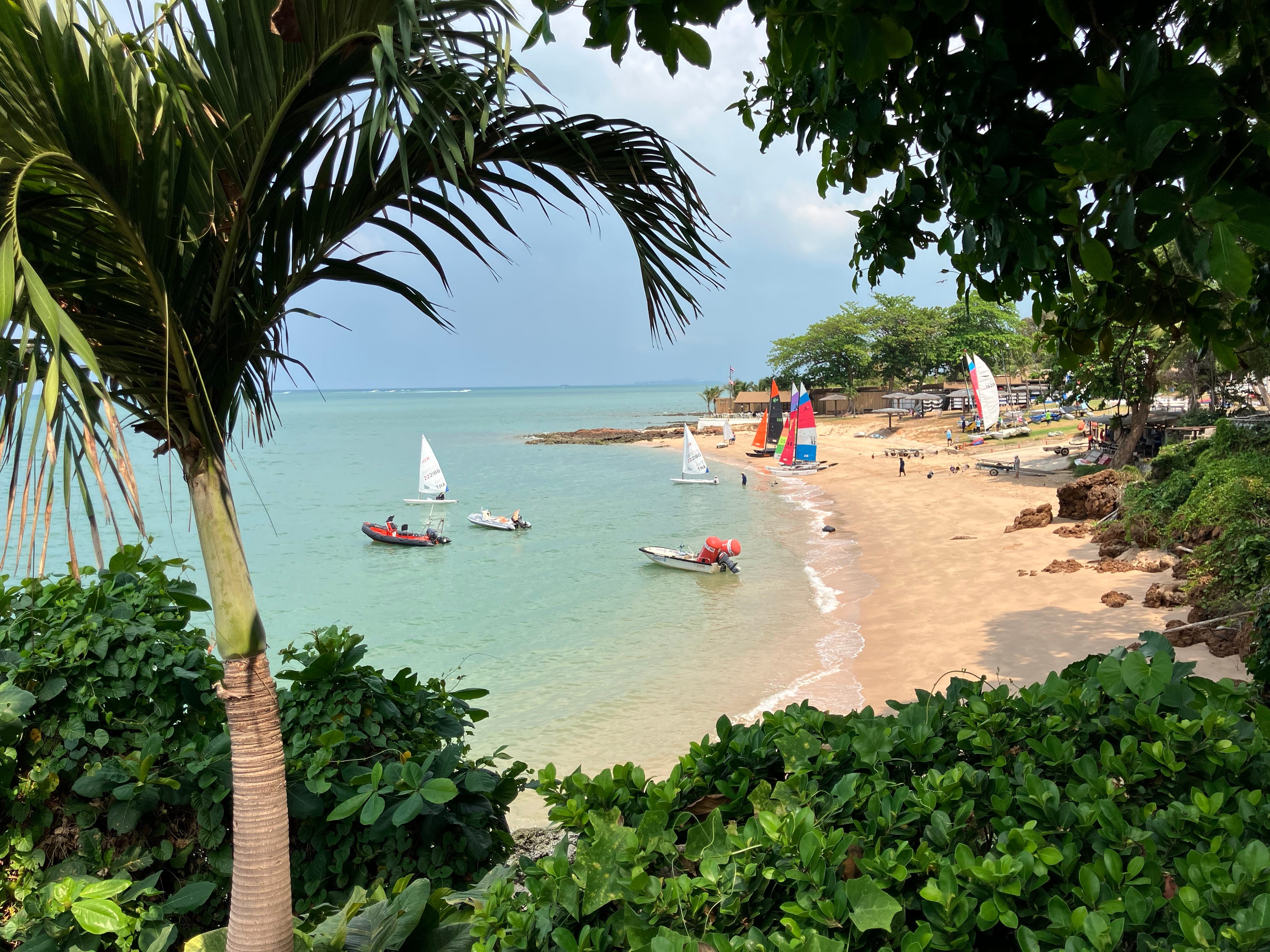
While traveling these past few weeks, I have felt very little urge to jump back into writing. Funny, how in this day and age where we can work from anywhere as long as we have our computers, there is still something about geography that makes a difference. Obviously, I am distracted and am prioritizing “being here now” in this experience of enjoying Thailand while I await a conference next weekend where I will give a talk. And very likely, I’ll feel called to dive back into my stories when I get back. Yet understandable as it may be, this lack of urge might have thrown a past version of me into high anxiety and self-recrimination.
Thankfully, I trust my writing self so much more now. I am building a track record of publications that helps me to do so. It’s interesting nonetheless, to recognize that my old ideas of what it means to be a writer no longer apply. From illusion to reality, here I stand. Realizing just how much the fantasy of being a writer powered things along the way — even if it mostly powered the beating up of myself. I spent so many years teeth gnashing, cajoling and judging myself. And after breaking on through to the other side? As the old Zen saying goes: “Before enlightenment, chop wood, carry water. After enlightenment, chop wood, carry water.”
So I find myself even having thoughts of whether or not I am meant to be a writer, though quickly deciding that the answer remains, “Yes.” This is actually a very recognizable phase in a creative life — especially for people whose motivations have shifted from ego-validation to meaning or curiosity. Earlier in life, the drive to write can come from a mixture of longing, identity formation, and ego energy: “I want to be a writer.”
That energy can carry a lot of thrust, but it also creates pressure and friction. Later in life when the writing becomes more real, a paradox can arise as the identity loosens. The question becomes less “How do I become a writer?” and more “Do I feel moved to write right now?”
In a twist, this can make writing both easier and less urgent. So the question in front of me now is not “Can I become a writer?” because I am already one. There is a quieter question that is something like: What role, if any, does writing want to play in this next phase of my life?
As I sit in a beautiful nature-filled resort on the coast of Thailand, this question feels amplified. Geography changes consciousness. And my nervous system is in recovery mode after the bustle of Bangkok. Swimming, meditating, watching the water, rehearsing my talk — these are all integrative states. Creative output often slows when the psyche is metabolizing experience.
There’s also another subtle factor. I spent decades with writing as a future identity. With arrival, the tension dissolves. Rather than that meaning that the writing disappears, I sense it is changing character. As in my recent expansion into writing continuing education courses for California therapists.
Instead of “I must prove myself through writing,” it becomes “Sometimes I feel moved to make something.” And having proven that I can participate in this show-and-tell, it comes back even more deeply into a connection with my values. For I have detected various patterns: how to game the system with the highbrow signs and signifiers of “literary” and “award-winning,” or how the younger generation, being digital natives, seem more vulnerable to validation-dependency via the statistics of social media acknowledgment. I think my favorite pattern is essentially: “If you build it, they will come” — the heartening way in which previously unsung creatives are periodically rediscovered, retrospectively reclaimed and celebrated.
Interestingly, a quieter relationship with one’s own creativity can often produce the most authentic work because there’s less internal pressure. You might end up writing fewer things more slowly but with deeper clarity. Or you might find that writing becomes one expression among several — alongside speaking, teaching, blogging, or simply living in the ideas.
So the most honest stance right now might simply be: “If writing wants to move through me, I’ll write. If it doesn’t, that’s also fine.”
That stance is very close to the non-attachment teachings I resonate with in ACIM, Seth, and the Law of One. Creation without compulsion.
And for what it’s worth, the trajectory I’m describing — publishing later in life, writing more freely, letting the work emerge without urgency — is actually very common among writers who produce their most mature work in their 50s, 60s, and beyond. Us so-called “Late Bloomers.” Huzzah!
Alright, that’s my share for today. Back to swim, meditate, feel the sea breeze, watch the birds, rehearse the talk.