


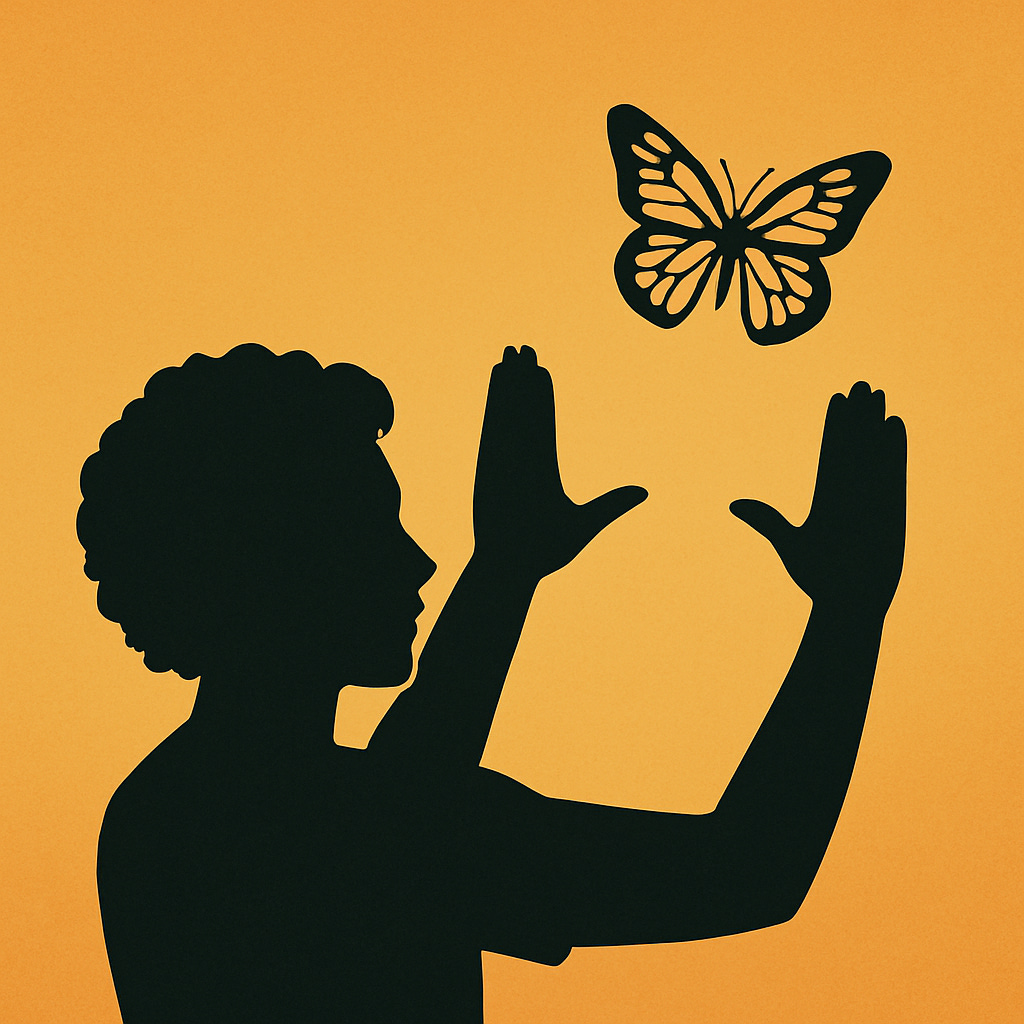
I recently stumbled into a surprisingly enlightening moment of digital confusion. It began innocently enough: I was looking for the 🙌 emoji on Facebook, the one I use constantly to symbolize the act of framing a vision—the way you might hold up your hands to imagine a scene, test an idea, or invite a new reality into existence. In frustration, I think I ended up just using the left and right hand emojis together.
My initial and base assumption about this emoji has always been that it looks exactly like the classic “frame the shot”gesture. That little filmmaker’s move: arms up, hands forming an invisible rectangle in the air, as if to say picture this or let me see how this might look. The quiet choreography of envisioning. A gesture of imagination before embodiment. For now in this emergent era most especially, are we not all exploring our abilities as auteurs?
Strange to find out that the official unicode semantics groups 🙌 under “emotion” because the official meaning is celebration/praise. The usage norms lean heavily toward the “hallelujah hands” reading: Spirit, triumph, communal uplift. This is a wonderful interpretation, yet one that had previously escaped me. Knowing that this meaning is the default—the one that digital culture has adopted widely—left me momentarily dumbstruck. Like if you ever find out that you’ve been using a word the wrong way, or spelling it wrong the whole time.
But my confusion wasn’t about creativity versus emotion at all; it was about taxonomy. Plain, simple, literal (perhaps this is where my neurodivergence comes into play). I simply assumed 🙌 would be sorted with the other hand gestures. It seemed self-evident: if it’s two hands making a gesture, it belongs in the ‘hands’ category. And this is exactly how most users expect emoji libraries to work.
So in my mental model, 🙌 belongs with:
🙏 prayer/namaste hands
👋 waving hand
🤲 cupped hands
🤌 pinched fingers
👏 clapping hands
🤟 I love you
✋ raised hand
and so on
I was following a coherent, intuitive structure that mirrors how most human brains naturally categorize physical gestures. I had a chuckle with myself when I learned this.
But the moment reminded me of something: Meaning is not fixed. Emoji meaning is therefore co-created. And it drifts. It evolves. It reveals more about our inner worlds than its designers could ever predict. Emoji scholars (there are legit researchers!) call this semantic drift—the way emojis pick up new meanings based on how communities use them.
This wasn’t the first time I had felt this little tug of symbolic mismatch.
In the early days of emoji, back when the library was comically sparse, I remember searching for a butterfly. A universal symbol of transformation. Psyche and metamorphosis. Death and rebirth. The archetype of emergence—wings unfolding after confinement.
There was no butterfly.
There was, however, a caterpillar.
And that’s when I realized:
These symbols were likely imagined and approved primarily through masculine-coded logic, even if not consciously—a design language shaped by linearity, sequence, and utility. Life cycle stages in order. Caterpillar → cocoon → butterfly. Of course we start with the caterpillar. Why leap to the luminous conclusion?
Whereas the feminine mind, or feminine-coded consciousness, tends to go straight to the archetype. To the symbol of transformation itself. The butterfly is the thing that matters. The meaning. The becoming.
Whatever we call that contrast—feminine and masculine energy, right-brain and left-brain, yin and yang—it shows up in places we don’t expect. Even in emoji.
Which brings me back to 🙌.
To me, it will always be the gesture of envisioning:
Hands lifted, palms forward, like a director composing a scene in midair.
A frame for a future moment.
A container for a possibility not yet embodied.
A portal for something just beginning to take shape.
Others may see celebration or praise—and that is fine. In fact, I feel like that makes a nice feature of this overarching concept of manifestation. Symbols are generous that way; they hold multitudes. But I love the subtle rebellion of using 🙌 as a tool of actualization rather than an expression of applause.
Sometimes the real magic lies in taking a symbol the world insists means one thing and letting it speak in an entirely different register.
After all, transformation is often the art of imagining something new inside something familiar.
Even if that familiar thing is two tiny upraised hands, floating on a screen, quietly offering to help you picture your next becoming.
🙌