


I didn’t set out to study trance. Looking back, it feels more accurate to say that trance kept finding me.
As a child, I was fascinated by consciousness. I remember staring into my own reflection, convinced that if I looked deeply enough I might somehow crack the code of reality. I would sit outside in the garden for long stretches with nothing to do except watch sunlight iridescences shimmer across the cracks of my skin, like a magical miniature desert playa. Becoming absorbed in wonder itself. I wasn’t chasing answers as much as inhabiting a way of paying attention that felt qualitatively different from ordinary experience.
My classmates noticed there was something unusual about me. They called me “spacey” and “weird.” Once I knew someone well enough, I’d eventually ask what I secretly thought was the real question: What do you think is actually going on here? You can imagine how well that landed in elementary school.
At the time, I had no framework for understanding these experiences. Years later I would discover that many of them shared the qualities of trance—not stage hypnosis or mind control, but naturally occurring states of absorbed attention that human beings enter every day. Like driving and forgetting how you got to the destination. Or being so immersed in a story that you’r reading or watching on a screen, that the rest of your surroundings just fall away.
My first psychedelic experience—with my Glastonbury tripper friends during my year abroad—surprised me for an unexpected reason. It didn’t feel entirely new. It felt strangely familiar, as though I had stumbled back into a landscape I had been visiting since childhood without having a name for it.
Then came graduate school, where I encountered the work of Milton Erickson. Later I had the privilege of training directly with Dr. Stephen Gilligan, one of Erickson’s longtime students. Somewhere along the way, I realized I wasn’t simply learning hypnosis techniques. I was gradually recognizing a thread that had been running through my own life all along.
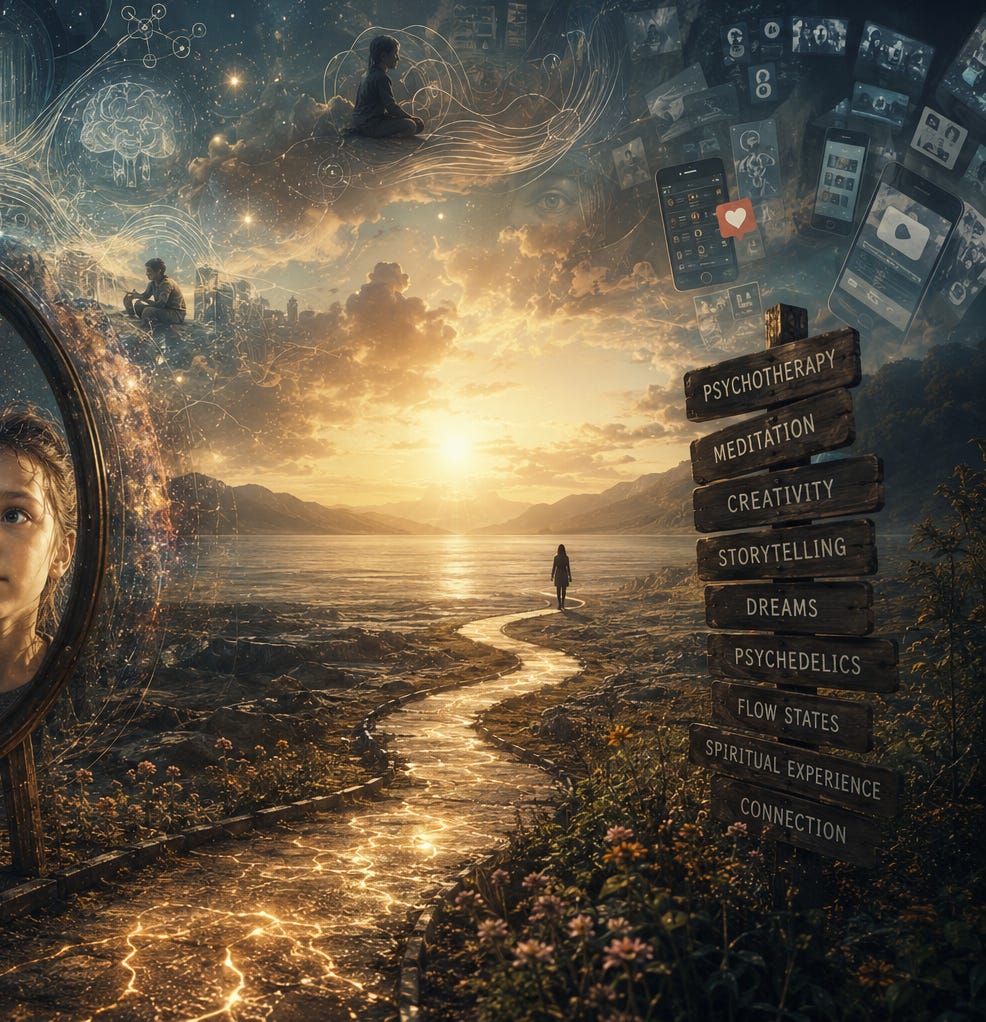
Looking back, I can see that trance has quietly shaped almost everything I care about: psychotherapy, meditation, creativity, storytelling, dreams, psychedelics, flow states, power exchange, spiritual experience, and even the simple act of becoming deeply absorbed in a good conversation. They all seem to orbit the same fundamental human capacity. I’m not saying that these experiences are identical. What fascinates me is that they all seem to recruit overlapping capacities of absorbed attention and flexible awareness.
The timing feels right to finally write about this.
I sometimes wonder what we’re losing when so much of our inner experience arrives pre-rendered. I remember reading about a study suggesting that people who watched the Harry Potter films before reading the books later reported less vivid mental imagery than those who encountered the stories first. I don’t know whether that one study tells the whole story, but it captures something I’ve been noticing for years—in therapy, in education, and in my own life.
Imagination seems to strengthen when we ask it to do more of the work. When we don’t immediately get what we want in the external realm. When we are forced to wait, to inhabit awkward silences and other liminal states. It’s the spaces between the busyness of life that can reveal the programming and frameworks which we arbitrarily impose, that allow us to shift further into a stance of healthy non-attachment and meta-observation.
We are immersed in forms of trance we rarely acknowledge. Advertising, algorithms, political messaging, outrage cycles, and social media all compete to capture attention and shape perception. We worry about hypnosis while overlooking the countless influences that quietly shape how we think, feel, and interpret the world.
Learning to enter intentional trance is, to me, an act of reclaiming agency. It is choosing where attention rests instead of constantly having it recruited by something else.
I also know this perspective will sound unfamiliar to many people. Trance has accumulated decades of cultural baggage, misconceptions, and caricatures. That makes it surprisingly difficult to talk about openly, even though its influence can be found throughout psychology, medicine, education, sports, the arts, and spiritual traditions.
Part of me would be more comfortable keeping these ideas private. They have been deeply personal for a long time. Bringing them into public view feels vulnerable because they sit outside many people’s existing frameworks.
Still, some ideas arrive when they are ready rather than when they are universally understood.
And so, I’ll be bringing my perspective into a greater public conversation through a friend’s podcast, Finding Treasures in the Trash with Cari Jacobs-Crovetto. And I am developing a website, Intentional Trance (still in pre-launch) as a vehicle to contribute to the conversation both clinically and for lay audiences. Attending my mentor Steve Gilligan’s Trance Camp residential ten years ago, he encouraged me to start creating my own offerings and community around the Erickson approach.
All these years later, I finally feel the call. And I’ve come to realize it’s not about wanting to ascend into some leadership role. It’s much more about fulfilling a sense of responsibility. Because I believe that this work is needed in the world right now. I have seen how it has changed my life, as well as the lives of countless clients.
When I was in grad school from 2009 to 2014, I couldn’t even find a professor specializing in mindfulness. Now mindfulness is all over mental health and medicine. During that time, I encountered a lot of misunderstandings regarding relational and sexual diversity—leading me to participate in the founding of Bay Area Open Minds, a 200+ strong therapist network affirming ethical non-monogamy, kink and LGBT+ communities. I volunteered with MAPS when psychedelic therapies were still considered fringe. Now ketamine treatment is mainstream. So I have hope that trancework can also take its rightful place as an important modality. One that emphasizes personal autonomy, the observing self, and the power of each individual to consciously reprogram their own psyche.
I don’t expect everyone to agree with my conclusions. My hope is much simpler: that together we become more curious about the extraordinary capacities of the human mind—and about the kinds of attention that quietly shape every moment of our lives.