


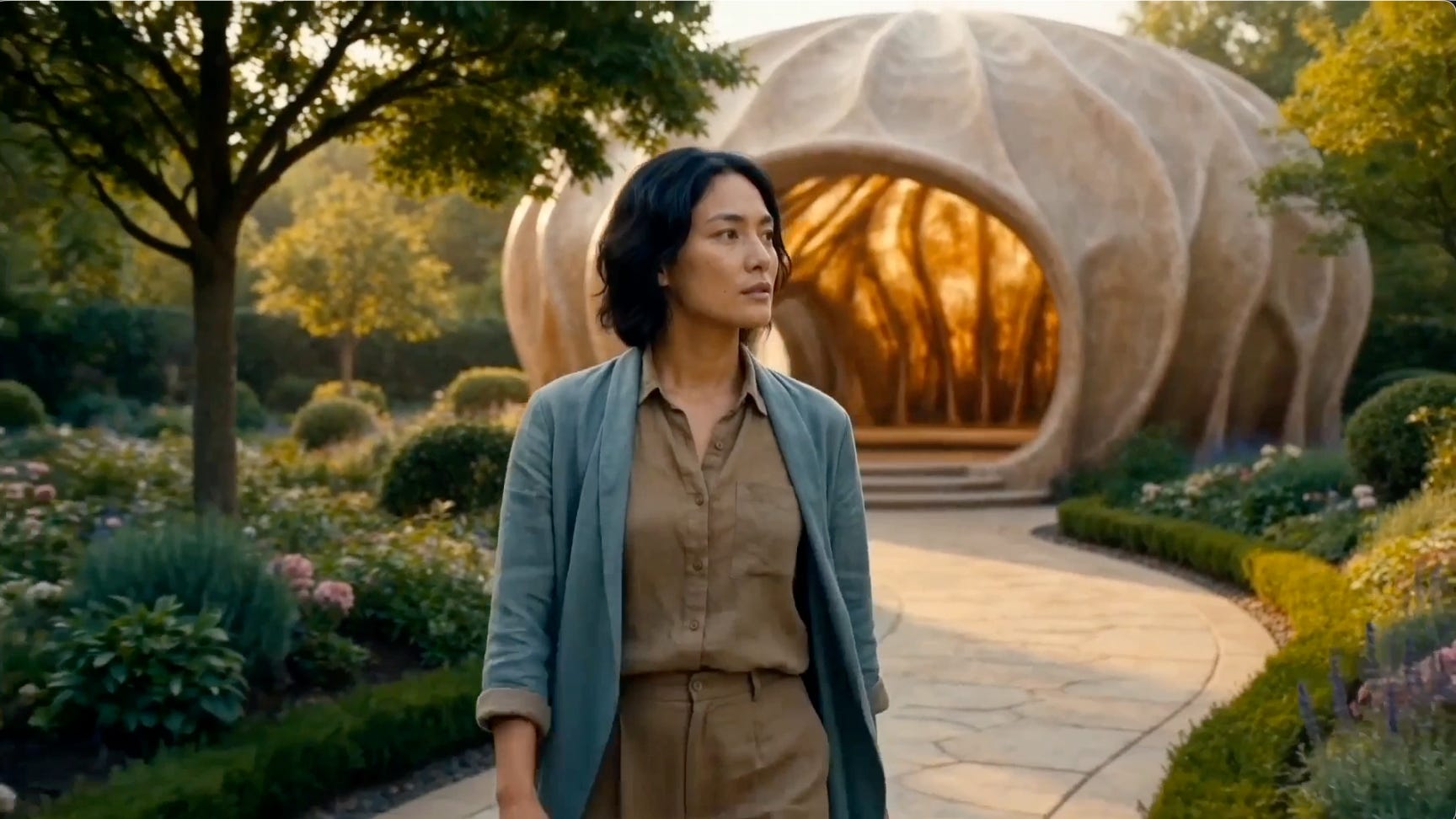
A few weeks ago, I wrote here that I had entered the XPRIZE AI for Humanity competition with a three-minute speculative film called SYNTHEOSYS, and that I would share more when I could.
The first Top 50 selections were recently announced, and SYNTHEOSYS wasn’t among them.
My immediate reaction surprised me: I was fine.
Of course I would have loved to advance. But what I felt most strongly was gratitude that I had followed the impulse to participate at all. I had a remarkably strong intuition that I needed to enter this competition, and making the trailer pushed me into creative territory I hadn’t explored before.
Then things got more complicated.
When I logged back into the competition’s Slack, I found a lively—and at times frustrated—conversation among participants about the selection process. Some questioned the transparency of the judging. Others wondered why so many selected visions seemed apocalyptic or fantastical when they had submitted scientifically grounded possibilities for the future.
Most consequentially, the organizers acknowledged that the accompanying written treatments had not been read during the initial trailer review. They subsequently announced that they were widening the field and would consider additional trailers.
That matters to me, although perhaps in a different way than it might have a few weeks ago.
My written treatment contained much of the conceptual architecture behind the three-minute film: ideas about interspecies communication, attention, aging, ecological restoration, perspective exchange, and AI as an amplifier of human understanding. A trailer can suggest those ideas. The treatment explains how they fit together.
Maybe SYNTHEOSYS will receive another look. Maybe it won’t.
Either outcome feels strangely secondary now.
The experience has clarified why I wanted to participate in the first place.
And now that I can share the trailer publicly, here it is.
SYNTHEOSYS imagines a future in which artificial intelligence becomes an accelerant for some of our most deeply human capacities: understanding other perspectives, communicating across species, restoring attention, caring for an aging population, protecting ecosystems, and solving problems whose complexity has exceeded our ability to hold all variables in one human mind.
But the experience of making it—and watching the conversation around the competition unfold—has clarified something larger for me.
I believe we are living through an epistemological rupture.
There is a popular story—almost certainly apocryphal—that when European ships first appeared off the shores of the Americas, Indigenous people were unable to perceive them because the vessels existed so completely outside their conceptual framework. In versions of the story, it is the shaman who first notices the disturbance on the water and gradually understands what is approaching.
I don’t take that story as history.
I take it as metaphor.
What happens when something appears on the horizon that our existing categories aren’t adequate to understand?
That is increasingly how this moment feels to me.
Ideas that seemed fantastical only a few years ago are becoming ordinary conversation. Artificial intelligence has crossed thresholds that were safely relegated to science fiction during most of my life. Discussions of unidentified anomalous phenomena and “disclosure” have moved from the absolute fringe into congressional hearings and mainstream media. Technologies that once sounded like thought experiments appear, sometimes almost casually, in our daily lives.
In one important sense, I think the singularity has already begun.
Perhaps there will eventually be some dramatic threshold historians identify as the singularity. But psychologically and culturally, the rupture is already here. The rate at which our assumptions about intelligence, creativity, expertise, reality, work, authorship, and even human exceptionalism are being destabilized is extraordinary.
And yet much of the public conversation still seems preoccupied with questions that feel strangely downstream to me.
How much electricity will the data centers use?
How can I tell whether this paragraph was written with AI?
Did that artist “really” make that image?
Is someone cheating?
Who is still the best human at doing something machines can increasingly do?
These are legitimate questions. Some involve enormous ethical and ecological stakes. But I sometimes feel that we are arguing about the wake while barely looking at the ship.
The train has left the station.
We are going to use these technologies. We are going to integrate them more deeply into medicine, education, science, art, communication, relationships, governance, and ordinary thought. There will be harms, distortions, abuses, resistance movements, regulations, adaptations, and consequences we cannot yet predict.
There will also be extraordinary possibilities.
So the question that interests me most is becoming less:
How do I prove that I am better than the machine?
And more:
What do I have to contribute when intelligence itself becomes abundant?
If AI can help almost anyone produce something technically polished, polish becomes less interesting.
Perfection becomes less interesting.
What is the message?
What is the value proposition?
What are you trying to discover, express, heal, illuminate, protect, build, or transmit?
What happens when these technologies become extensions of our cognition rather than competitors against it?
And perhaps most importantly:
What do we want to become?
That is the question underneath SYNTHEOSYS.
I am not an AI jingoist. I don’t think every technological development is good simply because it is new. I also don’t believe we can meaningfully respond to this moment by pretending that the transformation isn’t occurring.
I have spent much of my life standing in places that initially felt culturally peripheral.
In the 1980s, I was one of the weird kids reading comic books, playing Dungeons & Dragons, and listening to heavy metal, when all three could still reliably get you bullied.
In the 1990s, I embraced feminism when the word itself still carried considerably more social stigma than it does today. I was openly queer during a period when queerness remained deeply shame-laden for many people. I found Burning Man when it was still a strange experiment happening at the edges of mainstream culture.
In graduate school, in 2009, I helped cofound Bay Area Open Minds, a therapist collective oriented toward serving people practicing consensual non-monogamy and kink—communities that were still extraordinarily underserved and frequently pathologized by mental health professionals.
Again and again, I seem to find myself attracted to things before I can easily explain them to other people.
For a long time, I thought this was something I should correct.
Perhaps eventually I would become more conventional. Perhaps I would learn to wait until there was consensus. Perhaps I would stop being quite so drawn toward the edges.
At 52, I am beginning to suspect the opposite.
Maybe the edge is simply one of the places where I belong.
I see the same pattern in my psychotherapy work.
I began formal training in Ericksonian hypnosis and trance work in 2011. I was fascinated by it immediately. Yet it has taken me more than a decade to allow it to become a central part of how I work.
Some part of me kept waiting for the rest of psychology to catch up.
I kept waiting for these methods to become sufficiently validated by the culture around me that I would feel comfortable saying plainly what I had already experienced: human beings possess extraordinary capacities for altered attention, unconscious learning, imagination, somatic intelligence, and self-organization.
Psychedelics have helped reopen mainstream curiosity about these capacities. But psychedelic substances are only one doorway.
There are others.
You can learn to enter profound states of consciousness through your own nervous system.
You can learn to communicate differently with your unconscious.
You can discover forms of knowledge that don’t arrive as linear verbal reasoning.
And you don’t necessarily need a guru, a drug, or an expert telling you what you should find there.
Increasingly, I think my hesitation around this work came from the same place as my hesitation around publicly engaging with AI.
I was waiting for permission from the current paradigm to speak about the emerging one.
I’m less interested in doing that now.
I don’t experience embracing these developments as capitulation to some inevitable dystopia, nor do I experience skepticism as inherently wiser than curiosity. Both enthusiasm and fear can become forms of trance.
I am more interested in looking.
Standing on the shore.
Watching what is appearing on the horizon.
Trying to discern its shape before we have collectively agreed upon the vocabulary for describing it.
And planting whatever seeds I can for the consciousness we may need when it arrives.
That is why I entered the competition.
So maybe SYNTHEOSYS gets another look. Maybe this is as far as it goes (though I am already vibing with the idea of incorporating this story into the Glitchfall Continuum universe). Either way, I am less interested than I once was in waiting for a panel, a profession, or the prevailing culture to tell me when an idea has moved sufficiently far from the fringe to be worth exploring.
And that is what SYNTHEOSYS is ultimately about.
A future built through understanding.
Visit SYNTHEOSYS.com