


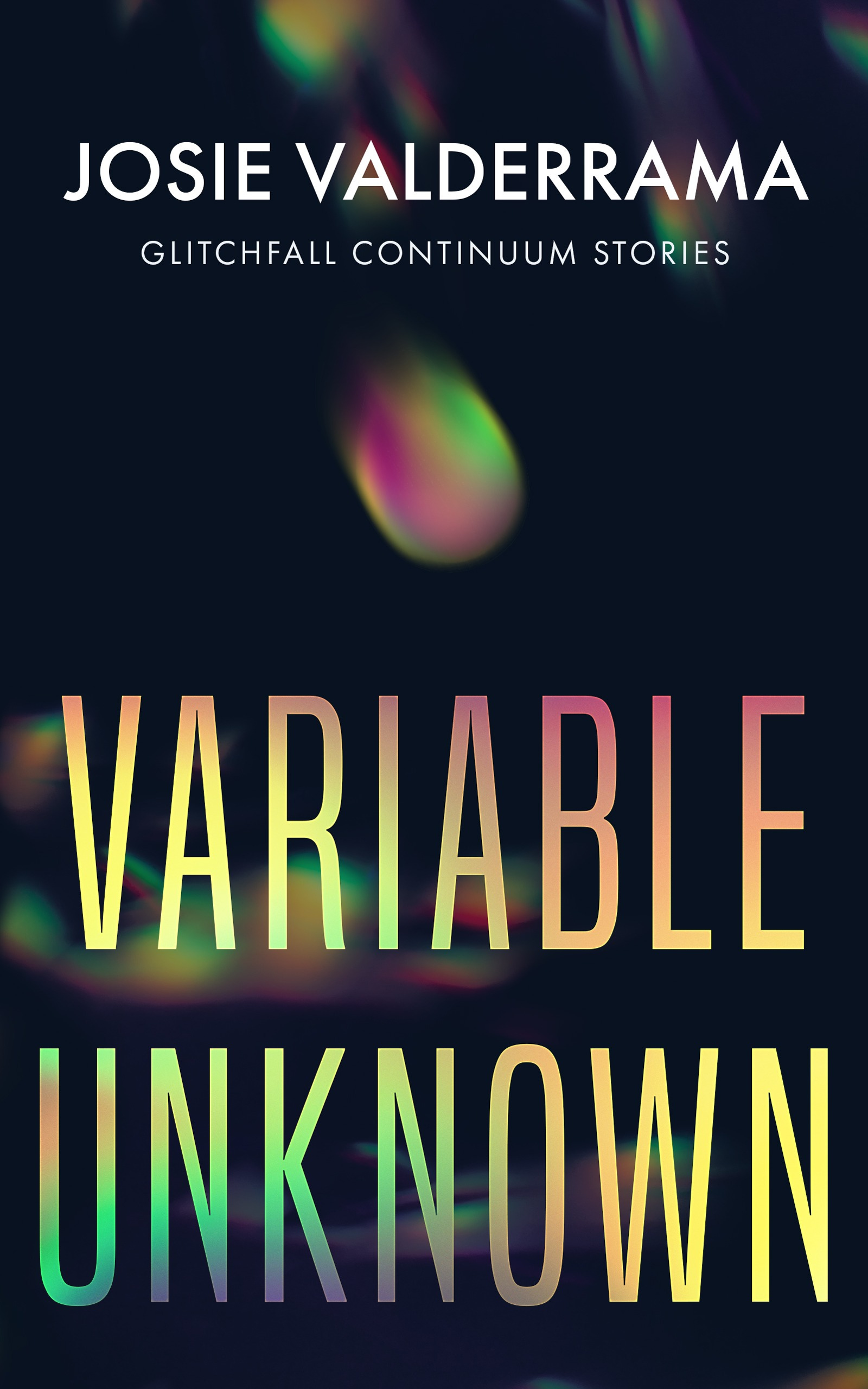
Tomorrow marks the release of Variable Unknown: Glitchfall Continuum Stories.
Whenever a new book comes out, there is an expectation that the author explain what it’s about. But lately I’ve found myself thinking about a different question:
Why am I still writing speculative fiction at all?
When I was young, the future felt mysterious.
I was drawn to cyberpunk, artificial intelligence, virtual realities, and all the strange possibilities that seemed just over the horizon. I devoured science fiction. I attended Singularity conferences. I imagined futures shaped by technologies that did not yet exist.
At the same time, I was fascinated by altered states of consciousness, dreams, synchronicities, spirituality, and the strange edges of human experience. Looking back, these didn’t feel like separate interests. They were different expressions of the same curiosity.
I wanted to know what lay beyond ordinary reality.
Back then, I thought the mystery was somewhere in the future.
Then something unexpected happened.
The future arrived.
Artificial intelligence became commonplace. Digital identities blurred with physical ones. Virtual worlds ceased to be science fiction and became everyday reality. Many of the technologies that fascinated me as a young reader are now woven into ordinary life.
And yet the mystery remained.
If anything, it became more interesting.
The questions that drew me into speculative fiction decades ago are still the questions that animate my work today:
Who are we beneath our identities?
What is the nature of personal reality?
How much of the world is objective, and how much is shaped by perception?
What happens when our stories about ourselves begin to break down?
Technology changed. The mystery didn’t.
Over the years I became a psychologist. I continued exploring questions of consciousness through both professional and personal avenues. I discovered writers such as Robert Anton Wilson who moved freely between fiction and nonfiction, skepticism and mysticism, psychology and philosophy. Whether or not one agrees with all of their conclusions, I admired their willingness to inhabit uncertainty and explore the edges of consensus reality.
Increasingly, I have found myself drawn toward synthesis.
Much of our culture seems organized around oppositions. Technology is either salvation or catastrophe. Artificial intelligence is either humanity’s greatest achievement or its greatest threat. Science and spirituality are treated as enemies. Rationality and mystery are expected to cancel one another out.
My experience has rarely matched those binaries.
The philosopher Hegel proposed that development often occurs through the tension of apparent opposites, eventually giving rise to a larger synthesis. While I make no claim to being a Hegelian scholar, I find myself returning to that pattern again and again.
Not technology or humanity.
Not science or spirituality.
Not skepticism or wonder.
But both—and whatever emerges beyond them.
That impulse runs through many of the stories in Variable Unknown.
These are not dystopian warnings. Nor are they utopian promises. The future, like the present, is likely to contain wonder and danger, confusion and insight, alienation and connection. Human beings have always lived among contradictions. Why should the future be any different?
What interests me is what happens when seemingly incompatible realities collide.
When a hyper-rational AI encounters mystery.
When virtual worlds become emotionally real.
When identity begins to dissolve and reform.
When technology forces us to ask ancient questions in new ways.
As a psychologist, I help people examine the stories through which they understand themselves. As a writer, I find myself exploring many of those same questions through fiction. Different genres, perhaps, but increasingly I suspect they are expressions of the same inquiry.
I used to think I was writing about the future.
Now I think I am writing about consciousness.
The future simply happens to be one of the places where that exploration unfolds.
Tomorrow the book officially launches. I’m grateful to everyone who has read these stories, encouraged the project, or shared an interest in the questions that inspired them.
The technologies will continue to change.
The mystery, I suspect, will remain.
Variable Unknown: Glitchfall Continuum Stories is available now on Amazon.